












How to Write Mix Notes Your Engineer Can Act On (Get Better Mixes Faster, Part 2 of 3)

Quick summary
To write mix notes your engineer can act on, listen to the mix on several systems (car, headphones, phone, computer speakers), sleep on it, and listen again before you write anything. Then send one organized list: start with what you like, describe the big picture next, and finish with specific changes in song order. For each change give the track time (“3:12 – 3:29”), name the instrument or voice, describe what you hear and say why you want it changed. Back up words like “warm” or “fizzy” with an example, and agree on the notes as a band before you send them. A copy-and-paste template is below.
Updated : completely rewritten and expanded with a listening routine, good and bad note examples, new diagrams, a section on band feedback, a copy-and-paste mix notes template and FAQs. Originally published October 8, 2018.
What’s In This Article
- What Makes a Good Mix Note?
- How Should I Listen to a Mix Before Writing Notes?
- Why Should Mix Notes Start With What You Like?
- What Order Should Mix Notes Go In?
- How Do I Write a Note the Engineer Can Act On?
- Should I Describe the Problem or Tell the Engineer How to Fix It?
- What Do Words Like Warm, Fizzy and Boomy Actually Mean?
- Good Mix Notes vs. Bad Mix Notes
- How Do I Combine Mix Notes From the Whole Band?
- A Mix Notes Template You Can Copy and Paste
- What If the Mix Is Way Off the Mark?
Get Better Mixes Faster, a 3-part series: Part 1: communicating with a remote mixing or mastering engineer · Part 2: writing mix notes (you are here) · Part 3: what not to do when having your music mixed online.
You worked hard to record your song and thought you hired the right mixing and mastering engineer. Then the first mix comes back, and you start to question your choice. What’s your next move? Ask for a refund? Hire a new engineer? Do it yourself?
Don’t give up hope yet. A first mix is a first draft, and most of the time the gap between that draft and the song in your head comes down to communication. This part of the series covers what to do when you receive a mix or master to review: how to listen to it, and how to write clear, organized and concise mix notes that get your engineer on the same page as you.
What Makes a Good Mix Note?
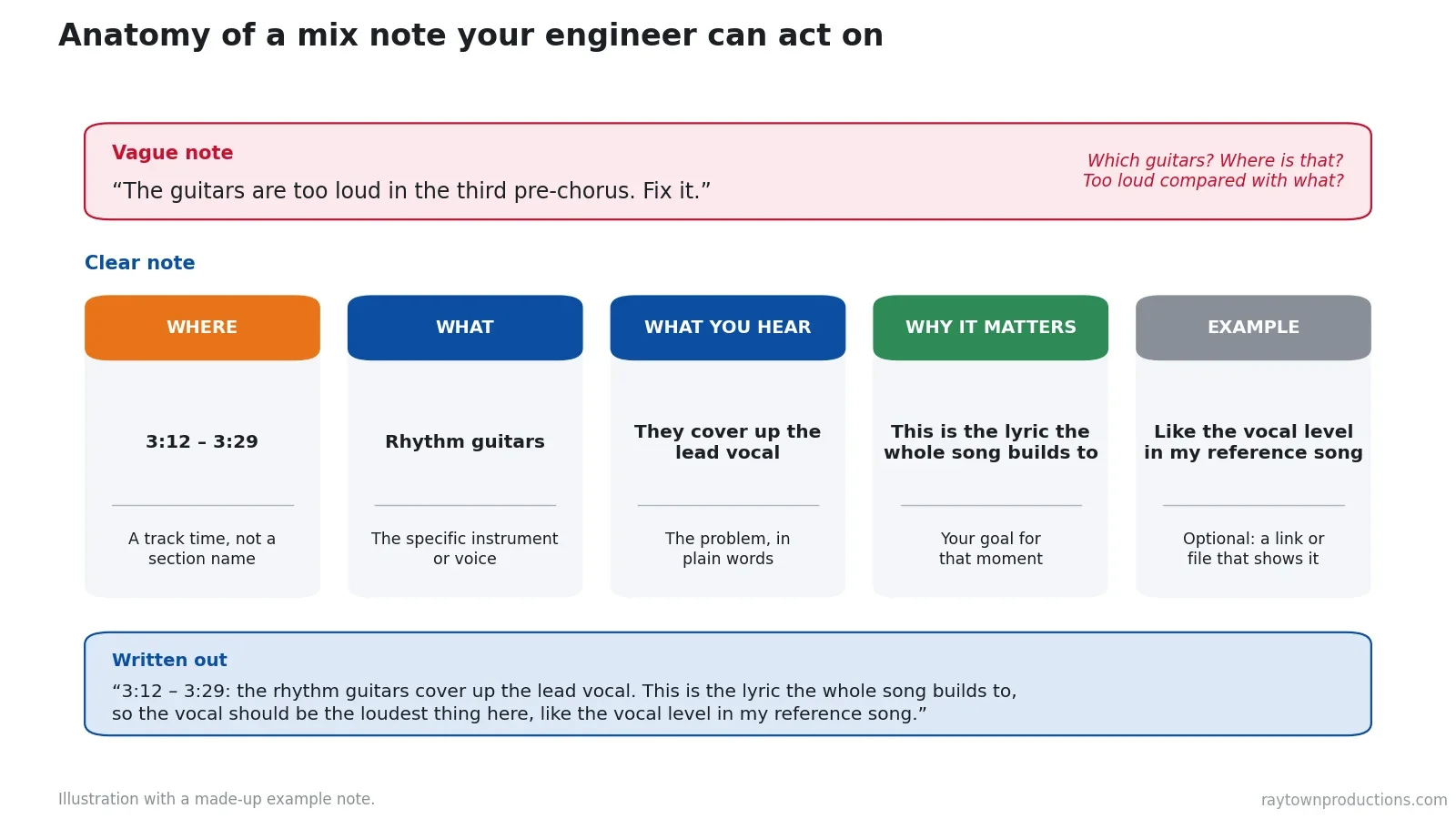
A good mix note tells the engineer where the issue is, what element it’s about, what you hear and why you want it changed. If one of those is missing, the engineer has to guess, and a wrong guess costs you a revision round.
Remember what I’m working with on the other end. I can’t see your face when the chorus hits, I don’t know what you call each part of the song, and I’ve never heard the version that lives in your head. Your notes are the only window I have. The clearer they are, the faster I can get the song where you want it.
| A good mix note has | Example | Why it helps |
|---|---|---|
| A track time | 3:12 – 3:29 | No confusion about which part of the song you mean. |
| The element | Rhythm guitars | The engineer knows which tracks to open. |
| What you hear | They cover up the lead vocal | Describes the problem and leaves the method open. |
| Why it matters | This is the lyric the song builds to | Lets the engineer see it from your perspective. |
| An example (optional) | A link to a reference song | Shows what the word you used means to you. |
How Should I Listen to a Mix Before Writing Notes?
Before you jump the gun and reply with an email saying you love or hate the mix, listen to the song on multiple sources: headphones, your car, your phone, computer speakers and anything else you normally listen to music on.
This matters because your fans most likely won’t be listening the same way you are. A good mix sounds great on all kinds of speaker systems, not just a few, so make sure it doesn’t fall apart on earbuds or in your car. The car is a great place to judge a mix: most people have listened to a lot of music there, so you already know how your favorite songs sound in it.
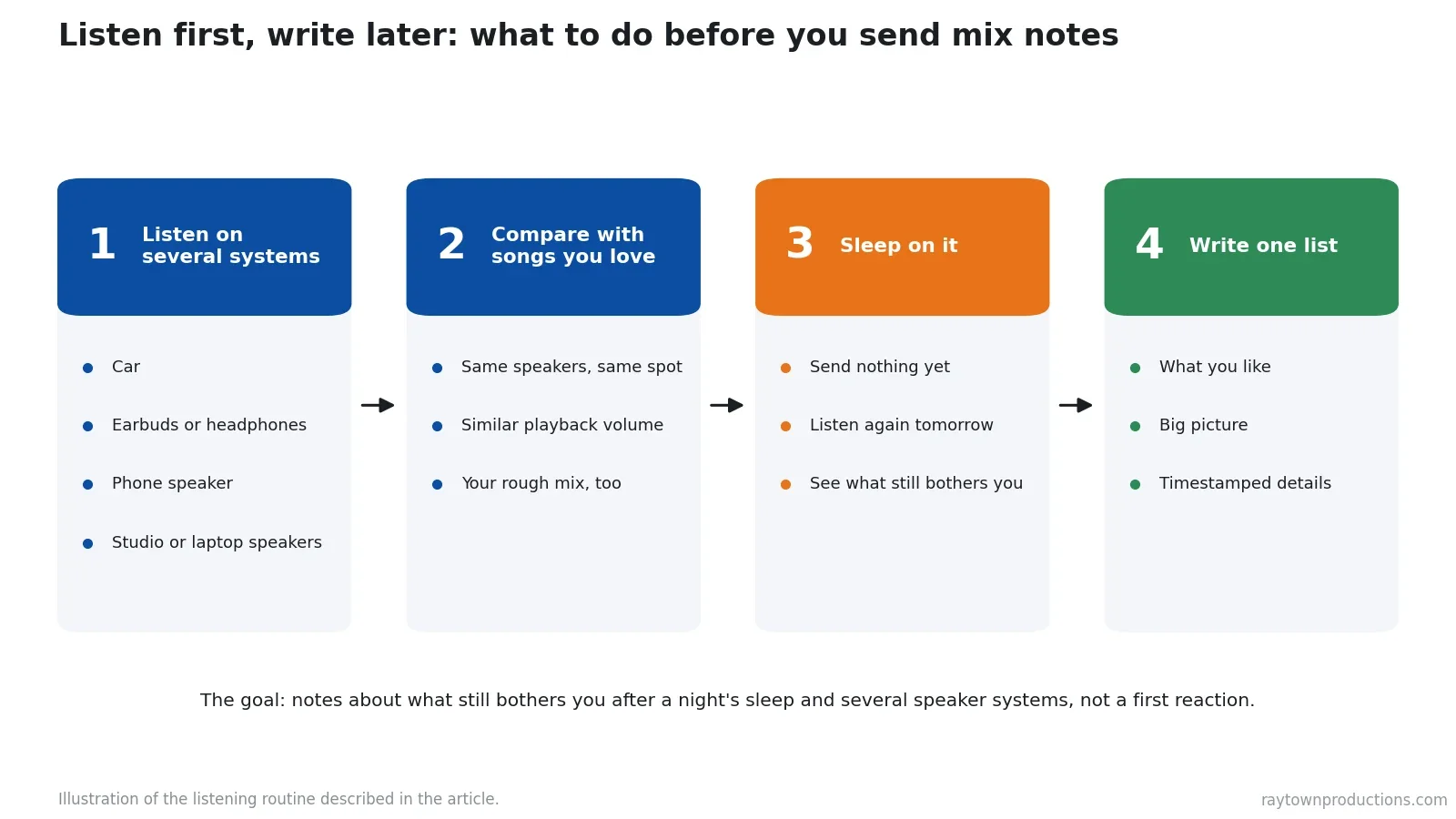
| Where to listen | What to check |
|---|---|
| Car | Overall balance and low end next to songs you know well on that system. |
| Earbuds or headphones | Details: vocal clarity, effects, panning, clicks, pops and edits. |
| Phone or laptop speaker | Small speakers reproduce very little bass. Can you still follow the vocal, the bass line and the kick? |
| Studio monitors or home stereo | The full picture, at a comfortable volume. |
| Next to a reference song | Tone and vocal level compared with a release you love, on the same speakers. |
Two things make the comparison fair. First, match the volume. When one of two versions is louder, the louder one usually seems better, so turn your reference song or your mix up or down until they feel about equally loud. Second, compare on the same speakers in the same spot. Your mix in the car against a reference on headphones tells you nothing.
Then sleep on it and listen again in the morning to see if your thoughts on the mix or master have changed. You’ve probably lived with your rough mix for weeks, and anything different from it can sound wrong at first simply because it’s new. A lot of first-night notes disappear by the next morning. The ones that are still there are the ones worth sending.
Keep a running list while you listen. Jot the track time and a few words in your phone’s notes app each time something catches your ear, on every system. Don’t send anything yet. After the second day, cross out what no longer bothers you and write up the rest.
If you’re not sure which of your speakers to trust, I ran a blind test of mixes made on headphones versus studio monitors that shows how much the playback system shapes what you hear.
Why Should Mix Notes Start With What You Like?
A good rule of thumb is to start the revision process with a compliment: say what you like and appreciate about the mix or master. That isn’t about being polite. It does two practical things.
- It builds trust and confidence between the artist and the engineer, which makes every later conversation easier.
- It tells the engineer what not to touch. If I know you love the drum sound and the vocal effects, I can focus completely on the problem areas and not question whether other parts of the song need more work.
Be specific here too. “Sounds good” doesn’t protect anything. “The drums hit exactly the way I hoped and I love the delay on the last line of the chorus” does. Without that, an engineer fixing your guitar note might also rework the drums you were happy with.
What Order Should Mix Notes Go In?
Start with the big picture, then get more focused. If your vision is a super modern, bright pop mix, say that first. If you instead describe every element of the song one by one as too dark or not bright enough, the engineer can feel overwhelmed and may overcomplicate their mixing strategy.
Focusing on the big picture often guides the engineer to a simpler and faster solution. Ten separate “brighter” notes can turn out to be one move on the whole mix. It also saves you from writing them. Part 1 of this series explains this big-picture-first approach, the mixing funnel, in more detail.
So the order of a good set of mix notes is:
- What you like, so it stays.
- Big picture: the overall tone, energy and balance. Does the vocal sit too low in every section? Is the whole mix darker than you wanted?
- Specific notes in the order they happen in the song, each with a track time.
- Questions for the engineer, if you have any.
After the first revision, big-picture notes should mostly be settled, and later rounds should get shorter and more detailed. If round three is still about the overall sound, that’s a sign to talk it through instead of writing another list (more on that below).
How Do I Write a Note the Engineer Can Act On?
Provide track times. If you want a guitar riff louder or the drums quieter in a specific part, say “at 3:12 – 3:29, reduce the volume of the guitar” instead of “in the 3rd pre-chorus, reduce the guitar”. As engineers, we don’t know how you name the different parts of your songs. Is the part after the second chorus a bridge, a breakdown or a post-chorus? There is no confusion when a time is provided.
Take the time from the file the engineer sent you, and mention which version you’re talking about (the file name is enough). If a note applies everywhere, write “whole song”. If it applies to every chorus, give the time of the first one and add “and every chorus”.
Name the element. “The guitar” could be any of six tracks. Say which one in words anyone would understand: the rhythm guitars on the sides, the lead guitar, the low harmony vocal, the 808, the snare. If you can’t tell what an instrument is, describe where it sits and what it does: “the high synth on the left that comes in at 1:05”.
One request per bullet. Write concise notes and give each adjustment its own line. A paragraph with four requests buried in it is how a note gets overlooked. A bulleted list also works as a checklist: the engineer can tick each one off, and so can you when the next version arrives.
Should I Describe the Problem or Tell the Engineer How to Fix It?
Describe the problem, and say why. Any feedback you give your mixing or mastering engineer should identify the problem with the mix and provide insight into WHY you want it changed. Having that context allows the engineer to see from your perspective and make better mixing or mastering decisions.
Here’s the difference. “Turn the reverb down on the vocal” is a fix. “The vocal feels far away in the verses and I want it to sound like she’s singing right in front of me” is the problem and the reason. With the second note I might turn the reverb down, or I might shorten it, add a little level, or change the compression. I know what you’re after, so I can pick the move that gets there without breaking something else.
The absolute worst thing you can do is say you don’t like something and give no constructive feedback. “I’m not feeling it” gives the engineer nothing to work with, and the next version will be a guess.
That doesn’t mean you can never ask for a specific change. A direct request is fine, and often the clearest note, when the result is simple to hear and you’re sure of it:
| Direct requests that work well | Better described as a problem |
|---|---|
| Level: “Lead vocal up a little in the verses.” | Tone: bright, dark, warm, harsh, thin, muddy |
| Mute or unmute: “Take out the tambourine at 1:20 – 1:40.” | Punch, weight and energy |
| Panning: “Swap the two guitars, the riff should be on the left.” | Space: closer, bigger, wider, drier |
| Fades and endings: “Start the fade at 3:40.” | How loud or aggressive the master feels |
| An effect on one moment: “Add a delay throw on the last word at 2:14.” | Anything you can’t quite put a name to |
| Errors: a click at 0:47, a cut-off word, a missing part |
Even with a direct request, add the reason when you can. “Vocal up a little in the verses, I’m losing some of the words” is better than the request alone. What rarely helps is prescribing the engineering itself, with exact frequencies and decibels. I go into why in Part 3 on what not to do.

Grab All My Favorite FREE Plugins!
What Do Words Like Warm, Fizzy and Boomy Actually Mean?
They mean something different to every person who uses them, which is exactly the problem. Minimize ambiguity by providing examples of what you mean.
If you think the guitars sound too fizzy, find an example of guitars that sound too fizzy to you and either send the file or give your engineer a link. Fizzy can mean a lot of things to different engineers, and without an example I’m left guessing. The same goes for warm, bright, deep, boomy, crunchy, sizzle and buzz.
| If you write | It could mean | Send this with it |
|---|---|---|
| Warm | More low mids, less top end, more saturation, or simply less harsh | A song with the warmth you mean, and which instrument to listen to. |
| Bright | More top end on the whole mix, or only on the vocal or cymbals | A reference, and whether you mean the whole mix or one element. |
| Fizzy / buzzy | Too much high end on distorted guitars, or a noise that shouldn’t be there | A track time where it’s worst, and an example of guitars you like. |
| Boomy | Too much bass overall, one note that jumps out, or a resonant kick | Where you heard it (car? earbuds?) and a track time. |
| Crunchy | More distortion, more midrange bite, or a tighter attack | A reference guitar or drum sound. |
| Punchy | Louder drums, a sharper attack, or more contrast between sections | The song whose drums hit the way you want. |
You can also point to your own song. “I want the vocal in verse 2 to feel like it does in the bridge at 2:40” is a perfect note, because the example is already in the session. And if the mix lost something your rough mix had, say so and name the moment: “in my rough mix the snare at 1:15 had more crack”.
When you send a reference song, say what to listen to. If you only love how the bass sounds, tell your engineer that. Without context, they might try to match the vocals too.
Good Mix Notes vs. Bad Mix Notes
Here’s how the same thoughts look as notes that won’t help and notes that will. The good versions present the adjustment, say why, and give the exact time in the song.
| Bad note | Why it doesn’t help | Good note |
|---|---|---|
| “I don’t like it.” | No problem, no reason, nothing to act on. | “The drums and bass feel great. Overall it’s darker than I pictured. I’m after a bright, modern pop sound like [reference link].” |
| “Guitars are too loud in the third pre-chorus.” | Which guitars? Where is the third pre-chorus? | “3:12 – 3:29: the rhythm guitars cover up the lead vocal. This is the most important lyric in the song.” |
| “Make the vocals warmer.” | “Warmer” isn’t defined. | “Whole song: the lead vocal sounds a little thin and sharp on earbuds. I’d like it fuller, like the vocal in [reference link].” |
| “The low end is weird.” | No location, no system, no description. | “0:45 – 1:15: in my car the bass gets boomy and I lose the kick. On headphones it’s fine.” |
| “More energy!!” | Could mean level, tone, drums, arrangement or loudness. | “2:05: the last chorus doesn’t feel bigger than the first one. I want it to lift when the extra guitars come in.” |
| “Fix the ending.” | Doesn’t say what is wrong with it. | “3:48: the final guitar chord gets cut off. Please let it ring out and fade naturally.” |
How Do I Combine Mix Notes From the Whole Band?
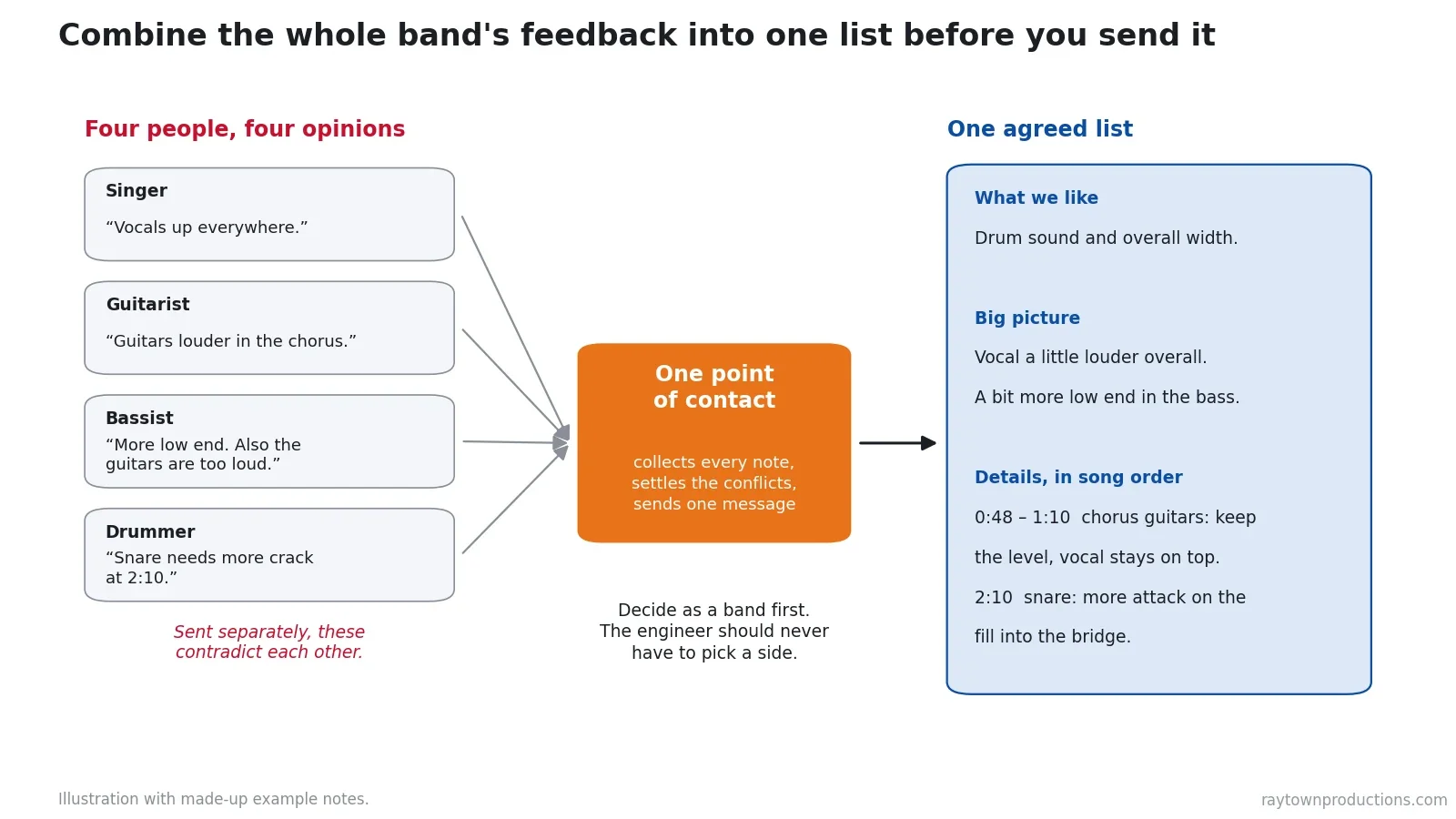
In a band, everyone hears their own instrument first. If four people each send their own notes, the engineer gets four lists that contradict each other: the guitarist wants more guitar, the bassist says the guitars are too loud, and nobody has decided who wins. That decision belongs to the band, not to the person mixing.
A simple way to do it:
- Pick one point of contact. One person talks to the engineer for the whole project.
- Everyone listens separately first, on their own systems, and writes down track times. Put the notes in one shared document so nothing gets lost.
- Merge the duplicates. Three people noticing the same thing is one note, and a good sign that it’s real.
- Settle the conflicts before you send. If two notes disagree, talk it out or let whoever has the final say on the song decide. If you really can’t agree, tell the engineer it’s an open question and ask for their opinion.
- Send one list, in one message, in the order from the section above.
The same applies to a solo artist with a producer, manager or label involved: collect every opinion first, then send one set of notes that everyone has signed off on. Sending notes in pieces is one of the mistakes covered in Part 3.
A Mix Notes Template You Can Copy and Paste
Here’s a framework you can copy into an email or a text file. Replace everything in brackets and delete the lines you don’t need. One song per list.
SONG: [song title]   MIX VERSION: [file name or version number]
LISTENED ON: [car, earbuds, phone, studio speakers...]

WHAT I LIKE
- [what is working and should not change]
- [...]

BIG PICTURE
- [overall direction: brighter, heavier, more vocal, more low end...]
- [reference song + link, and what you like about it]

SPECIFIC NOTES (in song order)
- [0:00 - 0:00] [instrument or voice]: [what you hear]. [why it matters or what you want to feel].
- [0:00 - 0:00] [instrument or voice]: [what you hear]. [why it matters].
- [whole song] [instrument or voice]: [what you hear]. [why it matters].

QUESTIONS
- [anything you are unsure about or want the engineer's opinion on]

Notes agreed by: [everyone who signed off on this list]
A filled-in specific note looks like this: “3:12 – 3:29, rhythm guitars: they cover up the lead vocal. This is the lyric the whole song builds to, so the vocal should be the loudest thing here.”
For mastering notes, use the same template, but keep in mind that a mastering engineer usually works on the finished stereo mix, not the individual tracks. Notes about the whole song (overall tone, loudness, the spacing between songs, fades) can be handled in mastering. A note like “turn up the snare” normally has to go back to the mix.
What If the Mix Is Way Off the Mark?
If the mix or master is not even close to what you had in mind, a longer list of notes usually isn’t the answer. It might be better to get on a phone or video call with the engineer if they’re available to chat. Emails can be hard to understand, and a conversation makes it much easier to clarify what the real issues are. Most of the time it’s faster to talk through your notes than to describe them in writing.
The challenge is finding a time when both of you are free, which gets difficult when you work with an engineer in another country.
A solution is a hybrid of an email and a phone call: voice notes. I worked with an artist who sent voice notes for all of his mix revisions, which allowed him to sing the specific parts he wanted changed. No amount of emails would have given me the clarity I needed to capture his vision of the song.
These days the format I like best goes one step further: a screen recording. Play the mix on your computer, record the screen with your microphone on, and talk through it, pausing wherever something bothers you. I can see exactly where you are in the song and hear what you mean at the same moment. So my order of preference for mix notes is a screen recording first, then voice notes or one organized email.
Making recorded notes work: ask your engineer first if they’re happy to receive them. Say the track time out loud before each point, sing or hum the part if that’s easier than describing it, and send everything in one recording or one message, not ten.
A mix that’s far off usually means the vision wasn’t clear at the start, so go back to the big picture: the references, your rough mix and the overall sound you described before the project began. And if you’re looking for an engineer who works this way, tell me about your project. My services FAQ explains how revisions work on songs I mix and master.
Get Better Mixes Faster, a 3-part series: Part 1: communicating with a remote mixing or mastering engineer · Part 2: writing mix notes (you are here) · Part 3: what not to do when having your music mixed online.
Key takeaways
- Listen before you write: several systems, next to songs you know, at a matched volume. Then sleep on it and listen again.
- Start with what you like so the engineer knows what to leave alone.
- Big picture first, then specific notes in song order.
- Every specific note has a track time, the element, what you hear and why it matters.
- Describe the problem. Ask for a direct change only when it’s simple and you’re sure: levels, mutes, panning, fades, errors.
- Define your words with a link or a file. “Warm” and “fizzy” mean different things to different people.
- One list from the whole band, with the conflicts settled before you hit send.
- Way off the mark? Call, or send a screen recording or voice notes.
Frequently asked questions
What are mix notes?
Mix notes, also called mix revision notes, are the written feedback you send your mixing or mastering engineer after hearing a version of your song. Good mix notes say what you like, describe the overall direction, and then list each change with a track time, the instrument or voice, what you hear and why you want it changed.
How long should I listen to a mix before sending notes?
Give it at least a day. Listen on several systems, such as your car, headphones or earbuds, a phone and computer speakers, compare it with songs you know and love, then sleep on it and listen again in the morning. Notes written after a second day of listening are shorter and more accurate than a first reaction.
Should I use timestamps in mix notes?
Yes. Write the track time, for example “3:12 – 3:29”, instead of “the third pre-chorus”. Your engineer doesn’t know how you name the parts of your song, and a time can’t be misread. A note that applies to the whole song can simply say “whole song”.
How many rounds of mix revisions are normal?
It depends on the engineer, so ask before the project starts. Some include a set number of revision rounds, others a time window. For songs I mix or master, you get unlimited free revisions for 10 days after you receive the first version. Either way, clear and complete notes mean fewer rounds.
Can I send voice notes or a screen recording instead of written mix notes?
Yes, if your engineer is happy to receive them. A screen recording of you playing the mix and talking through it is the format I like best, because I can see the exact spot in the song while you explain it. Voice notes and one organized email come next. Say the track time out loud for each point, and keep all of your notes together in one message.
Want a Mix You Don’t Have to Fight For?
I mix and master songs for independent artists, bands and producers. Tell me about your project and the sound you’re after, and we’ll dial it in together. Or learn to mix it yourself in my courses.