








Where Does the Tone Come From in a Guitar Tube Amp?
Quick summary
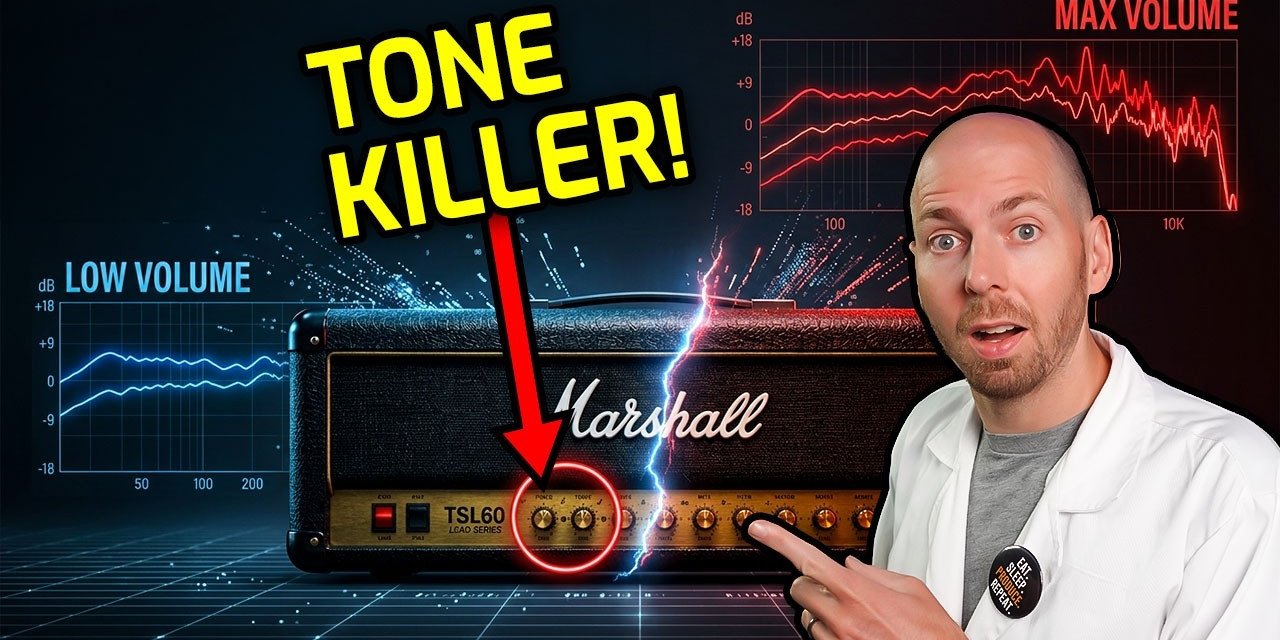
For years, I believed cranking my tube amp was the only way to get great tone. But after a deep dive into the science, I discovered the output stage knob does far more than just control loudness. It dramatically and non-linearly alters your guitar’s frequency balance, compression, harmonic density, brightness, and overall feel. Understanding these changes is key to dialing in truly killer rock and metal guitar tones.
What’s In This Article
- Understanding the Test Setup
- Frequency Changes: The Tonal Shift at Different Volumes
- Low Gain Frequency Shifts
- High Gain Frequency Shifts
- Compression: How Your Amp Squeezes Your Sound
- Crest Factor Insights
- Understanding Envelope Distribution
- Harmonic Content & Saturation: Adding Character (or Fizz)
- Unpacking Harmonics and Saturation
- The Spectral Centroid: Where Your Tone’s Density Lives
- Translating the Science: Practical Takeaways for Better Tone
Key moments in the video
- 0:00 — Introduction: Why Crank Amps?
- 0:53 — How Tests Are Performed
- 1:49 — Important Notes & Caveats
- 5:01 — Changes in Frequency Response (Low Gain)
- 4:05 — Changes in Frequency Response (High Gain)
- 8:32 — Key Frequency Changes Observed
- 9:16 — Difference Spectra: Low vs. High Output
- 13:15 — Tonal Differences Per Frequency Band
- 16:47 — Guitar Compression Behavior: Crest Factor
- 18:45 — Envelop Distribution: Compression Indicator
- 21:54 — Caveats About Harmonic Content Analysis
- 22:20 — Harmonic Content & Saturation Changes
- 25:38 — Spectral Centroid: Mapping Frequency Density
- 28:54 — LUFS Normalized Listening Comparison
- 35:18 — Massive Takeaways for Better Amp Tone
- 36:40 — Translating Findings to Better Production
- 37:21 — Unexpected Findings
Enjoying the Video?
Get more home-studio tutorials, mixing breakdowns, and gear deep-dives every week.
I’ve been told that to get truly great tone from a tube amp, you have to crank the output stage. It’s a common piece of advice in the guitar world, often repeated without much explanation of why or what exactly is happening under the hood. I wanted to put this theory to the test and figure out the real differences that occur when you turn your guitar amp’s volume really, really loud. More importantly, I wanted to understand what these findings mean for you, so you can set up your amp to achieve the best possible guitar tone for your music. To get the most realistic results, I didn’t rely on simple sine sweeps. Instead, I ran real DI guitar tracks through my Marshall TSL-60 tube amp and a Suhr Reactive Load Box, capturing the direct signal from the amp’s output. This allowed me to analyze the actual guitar performance at various volume settings. What I found was genuinely surprising: the volume knob isn’t just about making things louder. It’s a powerful tone-shaping tool that profoundly impacts your guitar’s frequency balance, compression, and harmonic content, often in non-linear ways. Let’s dive into the science and the listening tests to see what’s really going on.

Understanding the Test Setup
To conduct this experiment properly, I used my Marshall TSL-60 tube amp, paired with a Suhr Reactive Load Box. The load box is crucial because it allows me to take the direct signal straight from the amp’s output into my audio interface without needing a speaker cabinet, while still dissipating the amp’s energy. This setup ensures that what we’re analyzing is purely the sound coming from the amp’s power section, before any cabinet coloration or microphone influence.
I performed tests with two distinct preamp gain settings:
- Low Gain: A slight breakup on the lead channel, just enough to add some grit.
- High Gain: The lead channel’s gain set to about 75%, providing a heavily distorted signal.
For each gain setting, I tested four different output stage volume levels: low, mid, high (about 75%), and maxed out. It’s important to remember that these recordings are straight out of the tube amp, without any impulse responses or cab simulation, which is why they might sound a bit fizzy or unnatural on their own. This raw signal, however, is ideal for analyzing the amp’s direct output characteristics.
To ensure accurate analysis, I normalized the files in two ways: by Root Mean Squared (RMS) for the scientific analysis to focus on tonal and dynamic changes, and by LUFS (Loudness Units Full Scale) for the listening tests, which better represents human perceived loudness and minimizes bias.
Frequency Changes: The Tonal Shift at Different Volumes
One of the most immediate and impactful changes when adjusting the output volume is to the frequency content of your guitar tone. This isn’t just about overall loudness; it’s about how the balance of lows, mids, and highs shifts, proving that guitar amps are inherently non-linear devices. They react differently depending on how hard you drive their output stage.
Low Gain Frequency Shifts
At low gain, as we increase the volume from low to mid, we typically observe a drop-off in the top end. Moving from mid to high volume, this top-end loss continues, while other frequencies remain fairly consistent. However, when the amp is cranked to max output, something dramatic happens: the top end starts to creep back up, and we see an increase in the upper mid-frequencies. This creates a thicker, more pronounced mid-range, which can be perceived as a significant tonal shift.
High Gain Frequency Shifts
With a high gain setting, the trends are even more pronounced and, in some ways, different. The lowest volume setting actually yields the brightest guitar tone. As we move to mid volume, the top end rolls off. At high volume (around 75% output), a significant mid-range bump emerges, typically between 300 Hz and 900 Hz, adding considerable thickness. Simultaneously, there’s a huge loss in high frequencies. At max volume, we see a slight tightening of the sub-frequencies and the most pronounced bass and mid-range output, often accompanied by a roll-off of the fizzy top end. This shows that the preamp gain interacts significantly with the power amp’s behavior, leading to diverse tonal outcomes.
The ‘difference spectrum’ plots (which compare each volume setting to the lowest volume) clearly illustrate these non-linear changes. For high gain, you can see a much more consistent mid-range bump (up to 3 dB stronger), while the fizzy top end can drop by 12-13 dB, especially as you push the amp harder. This can be a game-changer for taming harsh highs in modern rock and metal productions.
Breaking down the frequency bands further, for high gain settings as volume increases:
- Low Mids: Consistently increase, adding weight and thickness.
- Low Energy: Fairly consistent, but can drop slightly from high to max volume, which might not be ideal for extreme low-tuned guitars (7- or 8-string).
- Mids (350-800 Hz): Continues to increase, potentially leading to a ‘boxy’ sound that might require carving out in the mix.
- Fizz and Air: Predominant at low volumes, then drops significantly when pushed hard. This is key for achieving a smoother, less abrasive tone.
While a real guitar cabinet and good mic placement can mitigate some of the fizziness, understanding these inherent characteristics of the amp’s output is vital. High and max volume settings might feel smoother when recording with a cab, but you could be losing valuable pick attack and presence.
Compression: How Your Amp Squeezes Your Sound
Beyond frequency, the output stage of your tube amp also acts as a dynamic compressor. This compression isn’t just about limiting peaks; it changes the entire feel and density of your guitar tone. We can observe this through two practical indicators: crest factor and envelope distribution.
Crest Factor Insights
The crest factor is the difference between a signal’s peak level and its average level. A higher crest factor means more transient punch, while a lower crest factor indicates a denser, more compressed signal. In my tests, the crest factor significantly decreased as the volume increased (e.g., from 12.5 dB down to 7.1 dB for low gain). This substantial drop confirms that higher volume settings are shaving down peaks and making the guitar performance much denser. However, it’s not always linear; at max volume, there can be a slight ‘recovery’ or change in character due to the amp being pushed into different operating regions, especially clipping.
Understanding Envelope Distribution
Envelope distribution plots show the variability between the quiet parts, the body of the note, and the peaks (like a pick attack). A wider spread indicates more dynamic range, while a narrower, steeper curve means the sound is more compressed and controlled. Essentially, a very narrow envelope distribution implies the signal quickly reaches its maximum amplitude and holds it, almost like a square wave, with little dynamic nuance.
For both low and high gain settings, max volume consistently produced a dramatically narrower envelope distribution, indicating a significant increase in compression. This compression is most likely due to the power tubes being driven into clipping, resulting in a very asymmetrical envelope.
This dynamic compression is crucial to the ‘feel’ of a tube amp. If you want more density, pushing the power section helps. If you want more pick attack and transient behavior, backing off the volume might be more effective, as these elements are often lost at higher compression levels.
Harmonic Content & Saturation: Adding Character (or Fizz)
Analyzing harmonic content and saturation in a musical context, rather than with pure sine sweeps, is more challenging but far more practical for guitarists. I used the ratio of energy above 2 kHz to energy below 2 kHz as a proxy to understand changes in upper harmonics, pick attack, and fizz.
Unpacking Harmonics and Saturation
For the low gain setting, increasing the output volume initially led to a darker tone, with the high volume setting being the darkest. However, cranking it to max volume resulted in a brighter tone than the starting point, possibly due to additional saturation and harmonics being generated. This increase in brightness can manifest as a stronger pick attack, more fizziness, or increased ‘bite’.
With high gain settings, where the preamp is already heavily distorted, the high and low frequencies are inherently closer together. As the output stage is pushed, the tone generally becomes darker, peaking at the high volume setting. This makes sense as the power amp is already fed a heavily saturated signal. This explains why a high volume setting might sound smoother, while max volume can sound hairier or fizzier due to the power amp’s unique saturation characteristics.
This non-linear behavior is also influenced by components like transformers, which can add saturation, and rectifier sag, a temporary voltage drop in the power section that occurs when the amp struggles to deliver enough power.
The Spectral Centroid: Where Your Tone’s Density Lives
The spectral centroid is essentially the ‘center of gravity’ of your frequency spectrum – where the most dense frequency content of your tone resides. For low gain, the centroid shifts lower as volume increases, indicating a darker, thicker tone, before jumping up at max volume. This jump signifies a shift in spectral density, reinforcing the non-linear changes.
For high gain, the results are even more striking. The centroid starts around 200 Hz, meaning the majority of the tone’s density is in the lower mids. As volume increases, the centroid shifts to progressively lower frequencies, making the tone darker, meatier, and thicker. Again, a slight shift back at max volume highlights the power amp’s non-linear behavior. This is crucial for understanding how to get that massive, dense guitar sound without it becoming muddy.
Translating the Science: Practical Takeaways for Better Tone
After all this analysis and listening, the biggest takeaway is clear: the power amp volume knob on our guitar amps is far more than just a loudness control. It’s a critical tone-shaping tool that profoundly changes the frequency balance, compression, harmonic density, overall brightness, and the very ‘feel’ of your guitar tone. And crucially, it does not operate in a linear fashion. Driving your amp too hard introduces unique behaviors that may or may not suit your specific musical context.
Understanding these different regions of your guitar amp’s output stage immediately opens up new possibilities for dialing in killer tones:
- For more density: Experiment with pushing your power section harder. The increased compression and mid-range emphasis can make your guitars feel massive.
- For more pick attack or transient behavior: You might want to dial the volume back. Our tests showed that much of this dynamic punch is lost at higher, more compressed output levels.
- To understand power amp compression: Try setting your preamp gain at a lower distortion level. This allows a more dynamic signal to hit the power section, letting you truly hear and feel how the power tubes react and compress.
- To tame fizzy top end: If you’re running a high-gain guitar tone, driving your power output section can significantly roll off the harsh top end. This was a surprising and valuable finding for me, especially for modern rock and metal productions where harshness is often a struggle.
Remember, the power amp doesn’t act in isolation. The amount of distortion from your preamp greatly influences how the output section behaves. A heavily distorted preamp signal will interact differently with the power tubes than a cleaner, more dynamic one. Experimentation is key, but now you have a scientific basis for understanding why your amp sounds the way it does at different volumes.
Key takeaways
- The power amp volume knob is a powerful tone-shaping tool, not just a loudness control.
- Cranking your tube amp non-linearly changes its frequency balance, compression, harmonic density, brightness, and overall feel.
- Higher volumes generally lead to increased compression and denser guitar tones, but watch out for non-linear ‘recoveries’ at max volume.
- Frequency response shifts are significant: top-end roll-off is common, but mid-range bumps and fizzy highs can emerge at extreme volumes, depending on preamp gain.
- For more pick attack, consider lower output volumes; for more density and to tame fizz on high-gain tones, pushing the power section can be beneficial.
- Understanding the interaction between your preamp and power amp is crucial for dialing in optimal tones.
Frequently asked questions
What happens to my guitar amp’s frequency balance when I crank the volume?
Cranking your tube amp’s volume knob significantly alters its frequency balance in a non-linear way. For low gain, you might initially lose top end, but at max volume, upper mids can increase and high frequencies can creep back up. For high gain, lower volumes are often brightest, with increasing volume leading to a pronounced mid-range bump and significant top-end roll-off, especially useful for taming fizz.
How does cranking my tube amp affect its compression?
Increasing your tube amp’s output volume leads to more compression. This is evident in a decreasing crest factor (meaning less transient punch and a denser sound) and a narrower envelope distribution (indicating less dynamic range). At max volume, the amp’s power tubes are often driven into clipping, resulting in a very compressed, controlled, and sometimes asymmetrical sound.
Does cranking a tube amp change its harmonic content and saturation?
Yes, cranking your tube amp’s output stage significantly changes its harmonic content and saturation. While not a formal THD measurement, analysis shows shifts in brightness, bite, and fizz. For low gain, tone might get darker initially before becoming brighter and fizzier at max volume due to added saturation. For high gain, the tone generally gets darker and meatier as volume increases, with max volume potentially leading to a ‘hairier’ or fizzier character depending on the amp’s specific non-linearities.
Is max volume always the best setting for tube amp tone?
Not necessarily. My analysis shows that max volume often introduces significant non-linear changes in frequency, compression, and harmonics that might not always be desirable. While it can add density and tame fizz for high-gain tones, it can also lead to a loss of pick attack, extreme compression, or an overly fizzy top end. Experimenting with different output levels allows you to find the ‘sweet spot’ that best suits your desired tone and musical context.
How does preamp gain interact with the power amp’s volume setting?
The preamp gain setting significantly influences how the power amp’s output stage behaves. A low-gain preamp signal allows the power amp to react to a more dynamic input, making its compression and tonal characteristics more apparent. A high-gain preamp signal, already heavily compressed and distorted, will cause the power amp to respond differently, often leading to more pronounced mid-range bumps and top-end roll-offs at higher volumes. The two sections do not act in isolation; they are highly interdependent.
Want to see the whole walkthrough? Watch the full video on YouTube.

![How to EQ Harsh Drum Cymbals in Metal and Rock Songs [JUST EQ]](/blog/s/img/wp-content/uploads/2021/09/Deharsh-Drum-Cymbals-440x264.jpg)