











Get Better Mixes Faster, Part 1 of 3: How to Communicate With a Remote Mixing or Mastering Engineer

Quick summary
To get the mix or master you want from a remote engineer, do most of your communicating before the work starts. Listen to the engineer’s past work and make sure they know your genre. Talk before you book, and agree on what is included, the turnaround time, how revisions work and which files you get back. Then describe your vision from the big picture down to the details, send the best rough mix of your song, and send reference tracks with a note on exactly what you like about each one. An engineer who understands your vision can get close on the first mix, and the revisions that follow are small.
Updated : completely rewritten and expanded with a pre-project question list, a mix brief template, new diagrams, a section on mastering and FAQs. Originally published October 1, 2018.
What’s In This Article
- Why Is Remote Mixing Harder to Get Right?
- How Do I Find the Right Mixing or Mastering Engineer?
- What Should I Discuss Before the Mix Starts?
- Is My Recording Good Enough to Mix?
- How Do I Describe the Sound I Want?
- Should I Send a Rough Mix of My Song?
- How Do I Choose Reference Tracks?
- What Should a Mix Brief Include?
- What Should I Tell a Mastering Engineer?
- How Should I Communicate While the Mix Is in Progress?
Get Better Mixes Faster, a 3-part series: Part 1 (this article): how to communicate before and during the project. Part 2: how to write the best mix notes. Part 3: what not to do when having your music mixed online.
Getting songs mixed and mastered online is commonplace. You can work with mixing and mastering engineers anywhere in the world, but it also means you won’t be in the room for your session. Simple mix adjustments can be very difficult to describe in an email or text message, which means they take much longer to correct.
This series gives you the tools I’ve developed over more than twenty years of mixing and mastering to cut down the time spent on revisions and get better sounding mixes and masters from any engineer. I know from experience that I can nail a mix or master quickly when I understand my client’s vision for the song. Part 1 covers everything that happens before the first mix arrives, plus how to handle the project while it’s in progress.
Why Is Remote Mixing Harder to Get Right?
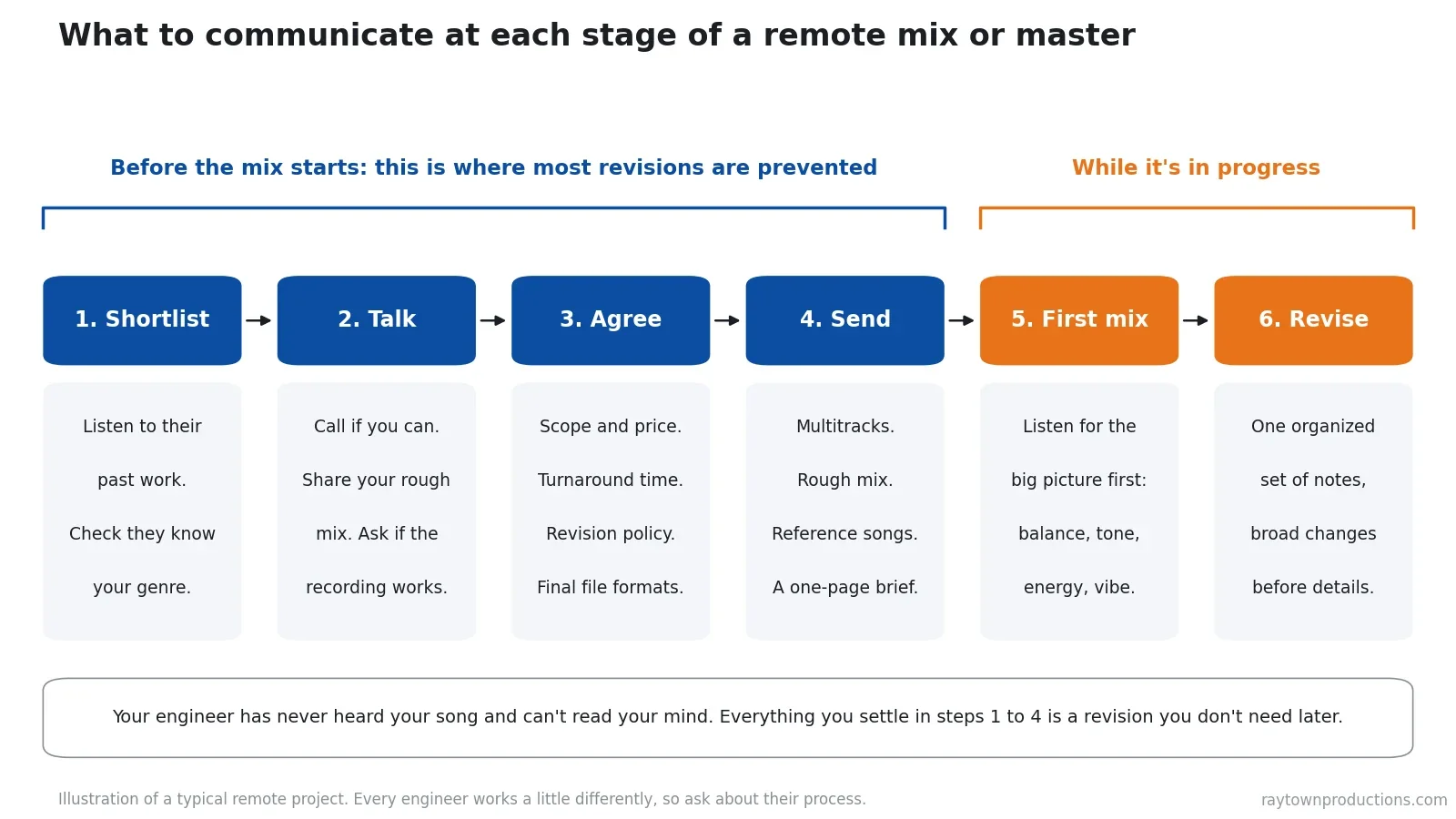
When you attend a session, you hear the mix come together, you react, and the engineer adjusts on the spot. Remote work removes that feedback loop. Your engineer has never heard your music and has no idea how you want the song to sound. All they have is your files and whatever you told them. It is your job to convey that vision, and the earlier you do it, the less there is to fix afterward.
How Do I Find the Right Mixing or Mastering Engineer?
First, you need a local or online engineer to talk to. A simple search is usually enough to find some candidates. Marketplaces such as SoundBetter list mixing and mastering engineers from around the world and let you contact them for a quote. If you’d rather skip the account and the long list of profiles, you can always tell me about your project.
Once you have a potential engineer, listen to their previous work. If their portfolio doesn’t sound great to you, there’s a good chance your music won’t either.
Then make sure the engineer is comfortable with your genre. Don’t hire a Grammy-winning jazz mastering engineer to work on your death metal record! An engineer who already knows the conventions of your genre needs far less explaining from you.
What Should I Discuss Before the Mix Starts?
Set up a consultation. This can be as simple as an email or text message, but I recommend picking up the phone or getting on a video call and having an actual conversation. Ten minutes of talking covers more ground than a week of messages, and you both find out whether you get along.
Use that conversation to agree on the practical side of the project:
| Ask about | The question | Why it matters |
|---|---|---|
| Scope | What is included? Mixing only, or editing, vocal tuning and mastering too? | These are often separate services. |
| Price | What does it cost, and when is payment due? | Every project is different, so get a quote for yours in writing. |
| Turnaround | When will I hear the first mix? | It depends on the engineer’s workload and the size of your session. |
| Revisions | How many revisions do I get, and for how long? | Policies vary a lot: a set number of rounds, a time window, or a fee per round. |
| Files in | What do you need from me, and in what format? | Most engineers have their own prep requirements for multitracks. |
| Files out | What do I get back? Instrumental, a cappella, clean version, stems? | Extra versions are easiest to make during the project. |
| Contact | How do you prefer to be contacted? | One agreed channel keeps every note in one place. |
So you know what answers look like, here are mine, straight from my services FAQ. A song is usually mixed in 3–5 days once the project starts, and mastering a song takes about 1–3 days. You get unlimited free revisions for 10 days after the first mix check. Editing and vocal tuning are separate services from mixing, so mention them up front if you need them. Other engineers work differently, so ask.
Be honest about your deadline, and keep it flexible. Tell the engineer if there’s a date you’re aiming for, but don’t announce a release date until the final files are in your hands. I explain why in Part 3.
Is My Recording Good Enough to Mix?
To make sure you aren’t setting your engineer up for failure, send your current mix of the song and ask for feedback on the recording quality before you book. Make sure the recording is workable. Sometimes tracks are so poorly recorded that no amount of mixing magic will save them, and it’s much better to hear that while you can still re-record a part.
Have realistic expectations, too. Don’t ever expect an album recorded with $50 of equipment in your friend’s garage to sound like an album with a $1,000,000 budget, recorded with professional gear in a well-designed studio.
HOWEVER, that is not an excuse to send in tracks that could have been better engineered with a little research on recording a band or a vocalist. Most importantly, capture GREAT performances. That makes the biggest impact on your final sound. For help on the recording side, read my guide to making better sounding records without breaking the bank.
If you want detailed feedback on a song before you commit to anything, I also offer a mix critique: a custom video review of your song.
How Do I Describe the Sound I Want?
When you describe your vision for your music, start with the big picture and work your way into more specific details. I think of it as a funnel.
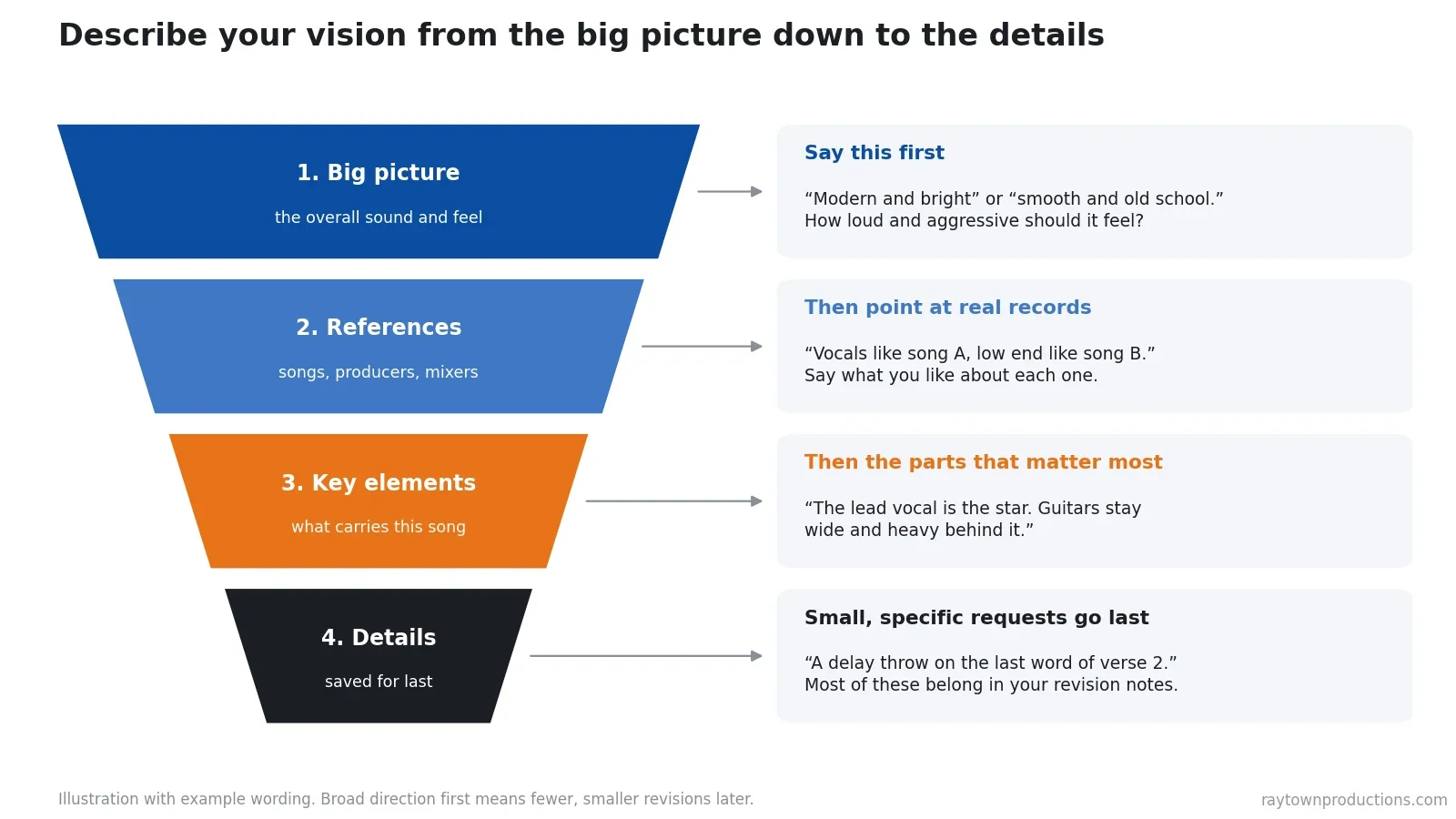
For hip hop or rap, start by describing the sound and feel of the track. Great descriptors are phrases like “modern and bright” or “smooth and old school”, because they separate opposing styles and mixing approaches. Vocals are so important to rap that you should also name specific songs from artists you want to sound similar to.
If you’re in a rock or metal band, it may make more sense to list the producer or mixing engineer of a particular album, or to say how loud and aggressive you want the mix or master to be.
Why broad adjustments first? If you describe every element one at a time (the vocal is too dark, the snare is too dark, the guitars are too dark), the engineer gets a long list and may overcomplicate the fix. “I want the whole mix brighter and more modern” says the same thing in one line and points to a simpler, faster solution.
| Too vague to act on | More useful |
|---|---|
| “Make it sound professional.” | “Modern, bright and polished, like current pop radio.” |
| “I want it to hit hard.” | “The kick and bass should be the loudest things in the mix, like the reference I sent.” |
| “Make it sound like this album.” | “I love the guitar tone and the loudness of this album. Ignore the drum sound.” |
Should I Send a Rough Mix of My Song?
Yes. Send the best mix of your song to the engineer for reference, and explain what you like about it and what you don’t. This is so important because a rough mix shows the balance you’re going for: how loud the vocal sits, which guitar part leads, where the ad-libs live. Those are choices an engineer can’t guess from the raw files.
The better this reference mix sounds, the more likely your vision will be understood.
If a mix doesn’t sound remotely close to the sound you want, DON’T send it as a reference. It will only confuse your engineer and waste everyone’s time.

Grab All My Favorite FREE Plugins!
How Do I Choose Reference Tracks?
If you’re going for the vibe of a particular song, share a link to it. YouTube links work great. References help an engineer get inside your head and understand the sound you’re trying to achieve. You could send one song for the airiness of the lead vocal that you love, and another for the hard-hitting bass you want pounding out of your sub.
Explain what you specifically love about each reference. If you only love how the bass sounds and not the vocals, tell your mixing engineer that! Without any context, the engineer might try to make your vocals sound like the reference you provided.
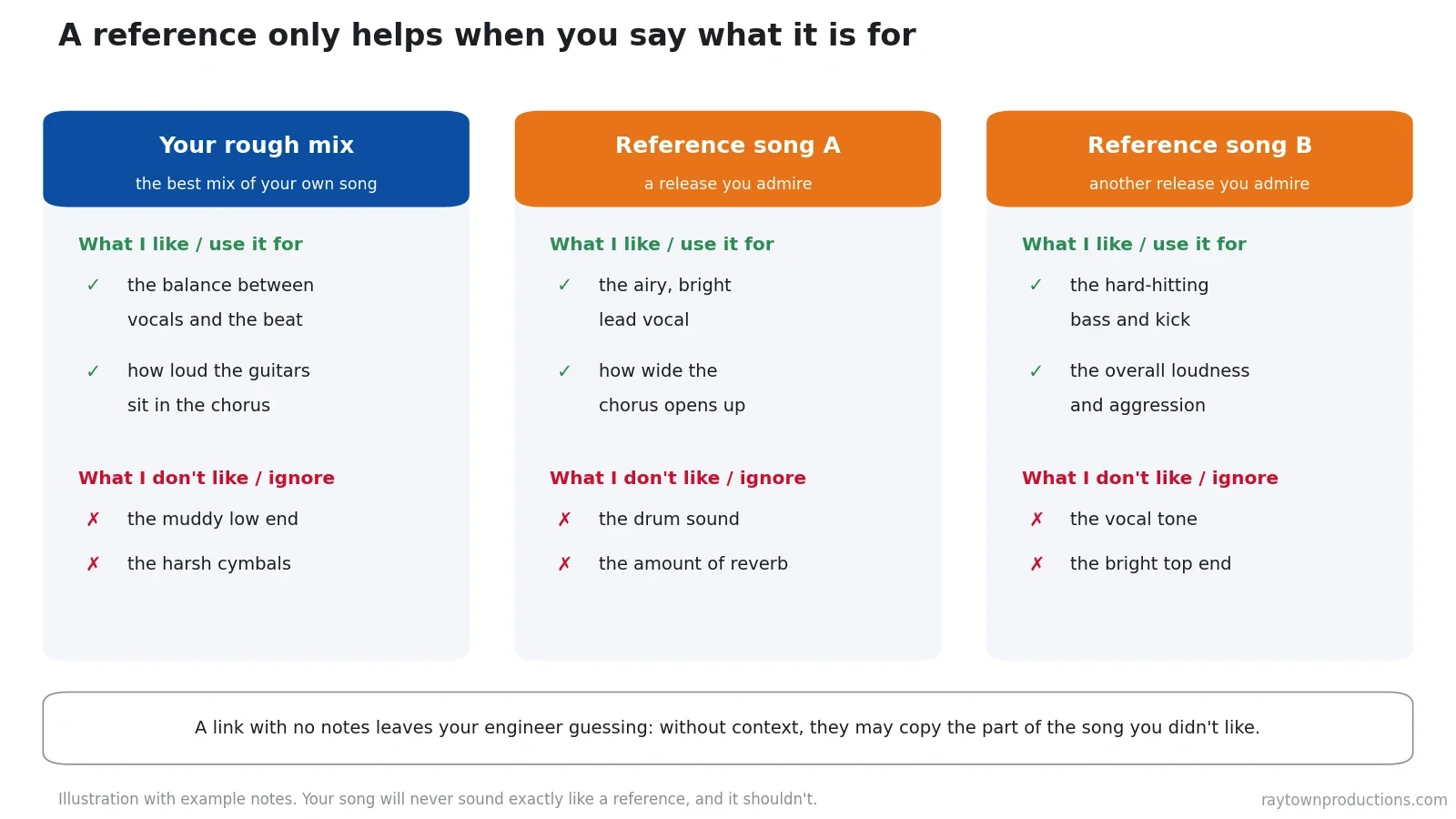
A few things make references more useful:
- Pick songs close to your own. A dense metal track is a poor guide for a sparse acoustic song.
- Keep the list short. There’s no magic number, but as a starting point, two or three songs with clear notes beat a playlist of twenty with none.
- Point to the moment. If you love the vocal in the second verse, give the time in the song.
Your song will NEVER sound exactly like the reference songs you provide, unless it was recorded at the same studio, with the same musicians, using the same gear, and engineered by the same person. EVEN THEN it will sound different. Embrace the difference and use it to define YOUR sound.
What Should a Mix Brief Include?
Put everything above into one short document and send it with your files. A page is plenty, and it keeps your vision in one place.
| Section | What to write |
|---|---|
| Song details | Artist name, song title, tempo and key if you know them. |
| The big picture | One or two sentences on the overall sound and feel. |
| What matters most | The elements that carry this song, and anything that must not change. |
| Rough mix | What you like about it, and what you don’t. |
| Reference tracks | A link to each, with what you love about it and what to ignore. |
| Known problems | Noisy takes, a part you’re unsure about, anything you’d like an opinion on. |
| Practical details | The scope, timing and deliverables you agreed on, and the one person who sends feedback. |
The brief covers the creative side. The files need their own preparation: clean edits, labeled multitracks and the right export settings. That’s all in my guide on how to prepare your songs for mixing.
What Should I Tell a Mastering Engineer?
Everything so far applies to mastering as well. A mastering engineer works with your finished mix, though, so a few other things are worth saying up front.
- How loud and aggressive you want it. The goal of mastering is to make the song as loud as it can be while keeping the punch and depth it needs. Masters at −6 LUFS and at −10 LUFS can both sound great. The numbers are a guide, not a rule, and a master that’s too quiet can be worse than one that’s pushed. A reference song tells me more than a number does.
- What you like about the mix, and what bothers you. Some problems are easier to fix in the mix, and asking early gives you the chance to fix them there.
- Where the music is going. Streaming, CD and vinyl can need different files. For an album or EP, include the track order and any spacing you want between songs.
How Should I Communicate While the Mix Is in Progress?
Once the files are sent, most of your work is done. A few habits keep the project moving:
- Answer questions quickly. A fast answer keeps your song on schedule.
- Speak with one voice. In a band, agree among yourselves first and have one person send the feedback.
- Flag changes right away. If you re-record a part or change the arrangement after sending files, say so immediately.
When the first mix arrives, use the funnel again. Judge the big picture first: the balance, the tone, the energy and the vibe. If the broad direction is right, the details are quick to fix. If it isn’t, a list of thirty small notes won’t get you there, and a conversation will. How to listen to that first mix and write notes your engineer can act on is the subject of Part 2.
Get Better Mixes Faster, a 3-part series: Part 1 (this article): how to communicate before and during the project. Part 2: how to write the best mix notes. Part 3: what not to do when having your music mixed online.
Key takeaways
- Communicate before the mix starts. Your engineer has never heard your song. Conveying the vision is your job.
- Choose on evidence: listen to the engineer’s previous work and make sure they are comfortable with your genre.
- Talk first, and agree on the terms: scope, price, turnaround, revisions, the files you get back and how to stay in contact.
- Check the recording. Send your current mix and ask if the tracks are workable.
- Big picture first. Describe the overall sound and feel, then references, then key elements, then details.
- Give every reference a job. Say what you love about it and what to ignore, and accept that your song will never sound exactly like it.
Frequently asked questions
How do I tell a mixing engineer what I want?
Start with the big picture and work toward the details. Describe the overall sound and feel first, for example “modern and bright” or “smooth and old school”, then name songs, producers or mixers that are close, then say which elements matter most in this song. Send a rough mix and reference tracks with a note on what you like about each. Save small, specific requests for your revision notes.
How many reference tracks should I send a mixing engineer?
There is no fixed number. As a starting point, send your own rough mix plus two or three released songs. What matters more than the count is the note that goes with each one: say exactly what you like about it, such as the airiness of the lead vocal or how hard the bass hits, and what the engineer should ignore.
Should I send a rough mix to my mixing engineer?
Yes, if it is reasonably close to what you want. Send the best mix of the song you have and explain what you like about it and what you don’t. It shows the engineer the balance you are after. If a mix sounds nothing like your goal, don’t send it as a reference, because it will only confuse things.
What should I ask before hiring an online mixing engineer?
Ask what is included (mixing only, or editing, vocal tuning and mastering too), the price, the turnaround time, how revisions work, which files they need from you, which files you get back, and how they prefer to be contacted. Also listen to their past work and check that they are comfortable with your genre.
Will my song sound like the reference track I send?
No, and it shouldn’t. Your song would only sound exactly like a reference if it had been recorded in the same studio, with the same musicians and the same gear, by the same engineer, and even then it would be different. A reference shows the direction, such as tone, balance and energy. Embrace the difference and use it to define your own sound.
Want a Mix That Matches Your Vision?
I mix and master songs for independent artists, bands and producers. Tell me about your music and where you want it to go, and I’ll reply with a plan and a quote. Or learn to do it yourself in my courses.








Trackbacks/Pingbacks